




Commercial & Multifamily Construction Defect Repair
Commercial construction defects rarely stay isolated to one wall, window, or unit. A leak that first appears as a ceiling stain or soft section of siding may trace back to failed flashing, an incomplete weather barrier, poorly integrated windows, roofing transitions, or waterproofing details installed incorrectly during the original build. On apartments, condominiums, hotels, senior living facilities, and mixed-use buildings, that hidden pathway can affect several occupied spaces before the full pattern becomes clear.
Pacific Exteriors NW investigates and repairs commercial and multifamily construction defects throughout Oregon and Washington. Since 1994, our work has combined exterior construction knowledge with building-envelope investigation, moisture diagnosis, documentation, and practical repair planning. We help owners and project teams understand what is failing, how far the damage extends, and what must happen next to correct the underlying problem.
Commercial Construction Defects Are Building-Envelope Problems
The exterior of a building works as a connected system. Siding, roofing, windows, doors, flashing, drainage planes, sealants, decks, balconies, and waterproofing transitions all have to move water away from the structure. When one part of that system is missing or incorrectly installed, water can travel behind finishes and emerge far from the original entry point.
That is why replacing one visibly damaged board or resealing one window may not solve a recurring problem. A useful construction-defect assessment looks beyond the symptom and evaluates the surrounding assemblies, transitions, and history of the property. For broader commercial exterior needs, visit our Commercial & Multifamily Services page.
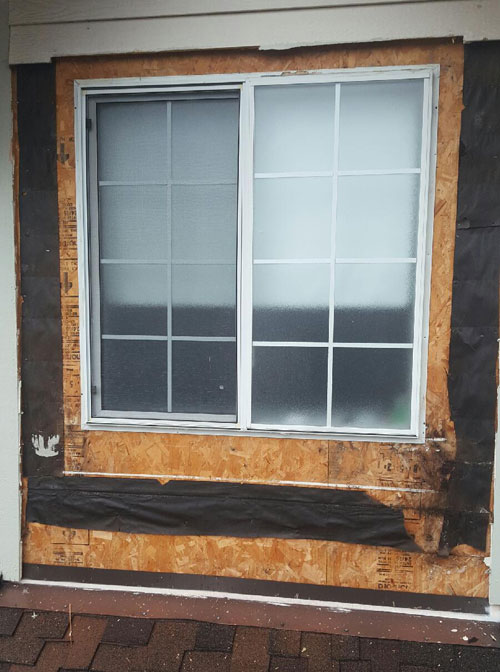
Construction Defects We Commonly Investigate
Every property is different, but many exterior failures begin with a small number of recurring installation and design problems. We evaluate how the visible damage connects to the surrounding building envelope, including:
- Missing, reversed, damaged, or poorly integrated window and door flashing
- Stucco, EIFS, fiber cement, or other cladding installed without reliable drainage and ventilation details
- Roof-to-wall, deck-to-wall, parapet, balcony, and penetration transitions that allow water behind the exterior
- Failed sealants or joints that were treated as the primary waterproofing system
- Incomplete weather-resistive barriers, drainage planes, or waterproofing membranes
- Improper clearances, fasteners, overlaps, terminations, or attachment details
- Concealed sheathing, framing, insulation, or interior damage caused by long-term moisture entry
Warning Signs Across a Commercial or Multifamily Property
Construction defects are not always obvious from the exterior. Property teams often contact us after repeated repairs fail, several units report similar symptoms, or a planned siding or window project exposes unexpected damage. Warning signs can include recurring leaks, staining around windows, swollen trim, soft siding, cracking or separation at transitions, persistent musty odors, mold associated with exterior water entry, rusting components, peeling interior finishes, or the same complaint appearing in multiple locations.
A pattern matters. One leak may look like a maintenance problem. Similar leaks on the same elevation, around the same window type, or after the same weather conditions can point to a broader installation failure. Our commercial forensic building-envelope consulting process is the right starting point when the source or extent of the problem is still uncertain.
Our Investigation and Repair Process
1. Property history and project goals
We begin with the symptoms, prior repairs, available plans or reports, affected areas, claim or warranty status, occupancy needs, and the decisions the owner or board must make. This helps determine whether the immediate need is investigation, emergency protection, repair planning, or a coordinated exterior project.
2. Building-envelope assessment
We review the visible conditions and the relationships between cladding, windows, roofing, decks, balconies, penetrations, and drainage paths. Depending on the property, the assessment may include infrared thermal imaging, moisture testing, selective openings, or other targeted investigation. Each method has limitations, so findings are interpreted together rather than relying on one reading or one photograph.
3. Define the defect and affected scope
The goal is to separate the entry point, the installation or material failure, and the resulting damage. Those are related but not always located in the same place. We document what can be confirmed, what remains uncertain, and where additional access or specialist input may be necessary.
4. Develop a repair strategy
A durable scope addresses the failed detail and the materials damaged behind it. Depending on the findings, work may involve cladding removal and replacement, flashing corrections, window or door integration, waterproofing, roofing transitions, sheathing or framing repairs, drying, and coordination with mold remediation when exterior moisture has created microbial growth.
5. Sequence work around the property
Commercial and multifamily repairs must account for residents, tenants, hotel guests, access, parking, weather exposure, noise, safety, and communication. We help plan phases and priorities so the project team understands what will be opened, how exposed areas will be protected, and how discoveries will be communicated.
Documentation for Owners, Boards, Insurers, and Legal Teams
When a defect involves a builder warranty, insurance claim, reserve decision, property transaction, or litigation, documentation must be clear enough for several people to understand the same conditions. We record observed damage, probable entry paths, affected assemblies, testing locations, photographs, limitations, and repair considerations. We can coordinate with property managers, HOA boards, consultants, attorneys, adjusters, architects, engineers, and other professionals without pretending to replace their separate roles.
Why Exterior Construction Experience Matters
An investigation is more useful when the person evaluating the failure also understands how exterior systems are assembled and repaired in the field. Pacific Exteriors NW has worked on Pacific Northwest exteriors since 1994. That experience helps us recognize where water commonly bypasses siding, roofing, windows, doors, and waterproofing systems, and how one repair choice can affect the rest of the wall or roof assembly.
We also understand that a commercial defect project is not only a technical problem. Owners and boards may be balancing reserve funds, insurance requirements, resident communication, operational continuity, legal deadlines, and the risk of opening a larger scope than expected. Our job is to make the exterior conditions and repair choices understandable so the responsible decision-makers can move forward with better information.
Properties We Serve
Our commercial construction-defect work includes apartments, condominium and townhome communities, HOA-managed properties, hotels, senior living facilities, mixed-use buildings, and other commercial structures. We serve the greater Portland area, Northwest Oregon, Southwest Washington, and projects elsewhere in Oregon or Washington when the scope is an appropriate fit.
Related Commercial Exterior Services
A construction defect is often connected to a larger exterior project. Pacific Exteriors NW also provides apartment siding replacement, hotel exterior and siding work, commercial waterproofing and envelope repair, forensic investigation, and coordinated remediation. If the full scope is not yet known, start with an investigation rather than assuming the visible damage defines the entire project.
Common Questions About Commercial Construction Defect Repair
What is the difference between a construction defect and deferred maintenance?
A construction defect generally relates to design, material selection, installation, or workmanship that did not perform as intended. Deferred maintenance develops when necessary upkeep is delayed. The two can exist together, and the visible condition alone may not reveal which one caused the damage. The property history, failure pattern, assembly details, and testing all help clarify the likely contributors.
Do you investigate the problem before proposing repairs?
Yes. When the source or extent is uncertain, investigation comes first. A repair proposal based only on a surface symptom can miss concealed damage or repeat the same failed detail. The appropriate level of investigation depends on the building, access, occupancy, and the decisions the findings must support.
Can you work on occupied apartments, condominiums, hotels, or commercial buildings?
Yes. Occupied properties require careful access, phasing, protection, scheduling, and communication. We discuss operational constraints before the work begins and coordinate with the owner, manager, board, or designated project representative.
Can you coordinate with our consultant, attorney, insurer, or engineer?
Yes. Complex projects often involve several specialists. We can provide exterior-construction observations, testing information, photographs, repair input, and field coordination while respecting the legal, architectural, engineering, environmental, or insurance responsibilities of the other professionals.
Do you provide expert-witness services?
That depends on the matter, the requested role, and the available records. Contact us with the property type, location, parties involved, and current stage of the dispute so we can determine whether our team is an appropriate fit or whether another specialist is needed.
Will you repair only the visibly damaged area?
Not automatically. We first consider whether the visible damage is isolated or part of a repeating condition. A limited repair can be appropriate when the failure is truly local. When the same detail appears throughout an elevation or property, a broader scope may provide better long-term value and reduce repeated disruption.
How soon should we respond to an active leak?
Protect people and property first. Document the conditions, limit additional water entry when it can be done safely, and contact the appropriate emergency or property-response team. Investigation should follow promptly because wet conditions can change, dry, spread, or be altered by temporary repairs.
Are you licensed in Oregon and Washington?
Yes. Pacific Exteriors NW holds Oregon Contractor License #215897 and Washington Contractor License #PACIFBS831MK. Both can be verified directly with the applicable state licensing agency.
Talk to Us About a Commercial Construction Defect
If your apartment, condominium community, HOA, hotel, senior living facility, mixed-use building, or commercial property has recurring leaks, unexplained moisture, cladding failure, mold connected to exterior water entry, or suspected installation defects, tell us what you are seeing and what decisions the investigation needs to support.
Request a project consultation, or call the office serving your state.
Washington: 360-907-1128
Oregon: 971-717-3053
Email: info@pacificexteriorsnw.com